Exercise of Power by Robert M. Gates
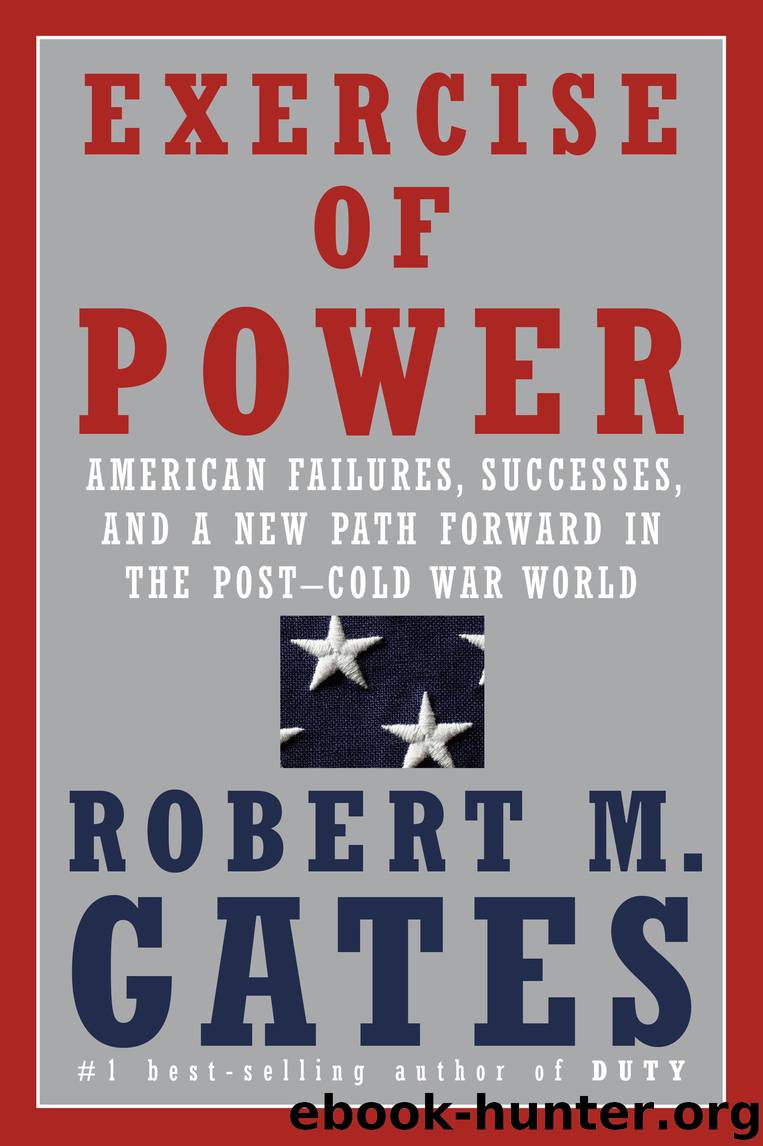
Author:Robert M. Gates [Gates, Robert M.]
Language: eng
Format: epub
Publisher: Knopf Doubleday Publishing Group
Published: 2020-06-16T00:00:00+00:00
* * *
—
With the creation of an interim Iraqi government in June 2004, the U.S. “occupation” of Iraq nominally came to an end, the CPA was terminated, and dealing with the Iraqis became the responsibility of the Department of State and the new U.S. ambassador, John Negroponte. Just the same, the security situation continued to deteriorate.
Overcoming the growing hostility of ordinary Iraqis required providing them with improved security and figuring out how to improve their daily lives. The electrical grid, water, sewers, schools—everything was a mess because of Saddam’s neglect, our bombing, years of sanctions, and the post-invasion looting. Local U.S. commanders did what they could to jerry-build fixes, especially for water and sewers, but that was not their primary mission, nor did they have the requisite expertise. Criticism by commanders of the lack of civilian support from the State Department grew steadily. There were just too few American civilian experts on the ground to seriously tackle the basic needs of the people. The complaint, however justified, obscured the reality that because of the lack of security, the military would need to provide protection for such civilians to do their work—and to protect whatever improvements they made from being destroyed by insurgents, terrorists, or militias.
Soon after becoming secretary of state in early 2005, Rice focused on how to not only improve State’s support of the military but also make progress in winning over the Iraqis by improving their living conditions. The result was to borrow an innovation from U.S. efforts in Afghanistan by creating Provincial Reconstruction Teams (PRTs), a hybrid force (as she described it) including military officers, diplomats, and reconstruction workers from various U.S. civilian agencies such as Agriculture, Justice, and USAID. Rumsfeld, who had praised the work of the PRTs in Afghanistan, resisted their use in Iraq and delayed their deployment by as much as six months. Rice inaugurated the first Iraqi PRT in Mosul in November 2005.
The PRTs had a very broad mandate. As described in various documents, they were to assist “Iraq’s provincial governments with developing a transparent and sustained capacity to govern, promoting increased security and rule of law, promoting political and economic development, and providing provincial administration necessary to meet the basic needs of the population.” They also were supposed to focus on repairing or replacing infrastructure, such as roads and schools, and provide key municipal needs, such as water, electricity, and sewage treatment. In their spare time, they also were to provide technical expertise to Iraqis in banking and finance, public health, agriculture, police training, and preparation of provincial budgets. Such an expansive mission was an illusion. There was a yawning chasm between the drafters of such plans in Washington and the reality on the ground in Iraq.
In Iraq, PRTs were led by a senior State Department officer and were larger than in Afghanistan and almost entirely civilian. PRTs not located at the U.S. embassy or a regional embassy office relied heavily on the U.S. military for security, transportation, food, housing, and other support.
Download
This site does not store any files on its server. We only index and link to content provided by other sites. Please contact the content providers to delete copyright contents if any and email us, we'll remove relevant links or contents immediately.
Fanny Burney by Claire Harman(26616)
Empire of the Sikhs by Patwant Singh(23094)
Out of India by Michael Foss(16865)
Leonardo da Vinci by Walter Isaacson(13352)
Small Great Things by Jodi Picoult(7171)
The Six Wives Of Henry VIII (WOMEN IN HISTORY) by Fraser Antonia(5525)
The Wind in My Hair by Masih Alinejad(5110)
A Higher Loyalty: Truth, Lies, and Leadership by James Comey(4975)
The Crown by Robert Lacey(4827)
The Lonely City by Olivia Laing(4811)
Millionaire: The Philanderer, Gambler, and Duelist Who Invented Modern Finance by Janet Gleeson(4493)
The Iron Duke by The Iron Duke(4373)
Papillon (English) by Henri Charrière(4283)
Sticky Fingers by Joe Hagan(4212)
Joan of Arc by Mary Gordon(4125)
Alive: The Story of the Andes Survivors by Piers Paul Read(4042)
Stalin by Stephen Kotkin(3976)
Aleister Crowley: The Biography by Tobias Churton(3651)
Ants Among Elephants by Sujatha Gidla(3476)
